


 Home
Home
DB3000V is a platform developed by Fukukawa Technology to adapt to the IT era of broadcasting and television centers. Its goal is to migrate traditional digital mixing consoles characterized by dedicated DSP processing to COTS platforms marked by cloud architecture and cloud processing, and to achieve virtualization, cluster deployment, operation, and management of production and broadcasting mixing consoles, providing a solid foundation for integrating broadcasting IP resources and promoting media integration.
The DB3000V adopts a standard private cloud infrastructure and interacts with external audio data in the form of AES67 streams. By creating virtual machines on the private cloud platform to support the operation of the virtual mixing console, the underlying operating system and audio algorithms are deeply optimized, and all signal processing functions of traditional mixing consoles are implemented in virtual containers. Private cloud platforms can integrate dispersed hardware facilities such as servers into a unified resource pool. On the one hand, the redundancy features included in this process and mechanism provide users with security guarantees and fast fault recovery, and can cover virtual mixing consoles deployed in the cloud; On the other hand, the high computing power and scalable elastic services of resource pools provide the foundation for establishing flexible and available large-scale systems, improving resource utilization, reducing costs, and ensuring system continuity and scalability.
Creating a virtual mixing console cluster within a private cloud platform has implemented a new signal flow and management mode. Simplify the traditional physical routing between different data centers into virtual routing within the cloud, achieving the goal of deeply simplifying the system, integrating signals, and sharing signals. The local signal is collected by the audio routing device and sent to the cloud in the central computer room for virtualization mixing processing. The monitoring signal is then sent back to the computer room for the host to monitor. The PGM broadcast signal can be directly output by the cloud platform to reduce the repeated round-trip of the signal in different rooms. In the event of a malfunction in the computer room, signals and processes are not disrupted and can be mirrored to other computer rooms for continued live streaming.
The introduction of cloud platforms helps to establish a unified device and signal management system to support the control and monitoring of the entire virtual mixing console cluster, and to achieve software defined mixing consoles, routing, and workflow. The management system runs within a virtualization platform and is connected to various entities and virtual devices through an AoIP network.
technical performance

Total signal processing delay:<10ms
Networking method: redundant/stacked
Audio stream format: AoIP (following GY/T 304-2016 standard)
Virtual mixing console control methods: physical panel, computer/tablet, virtual/real backup mixing console
application mode

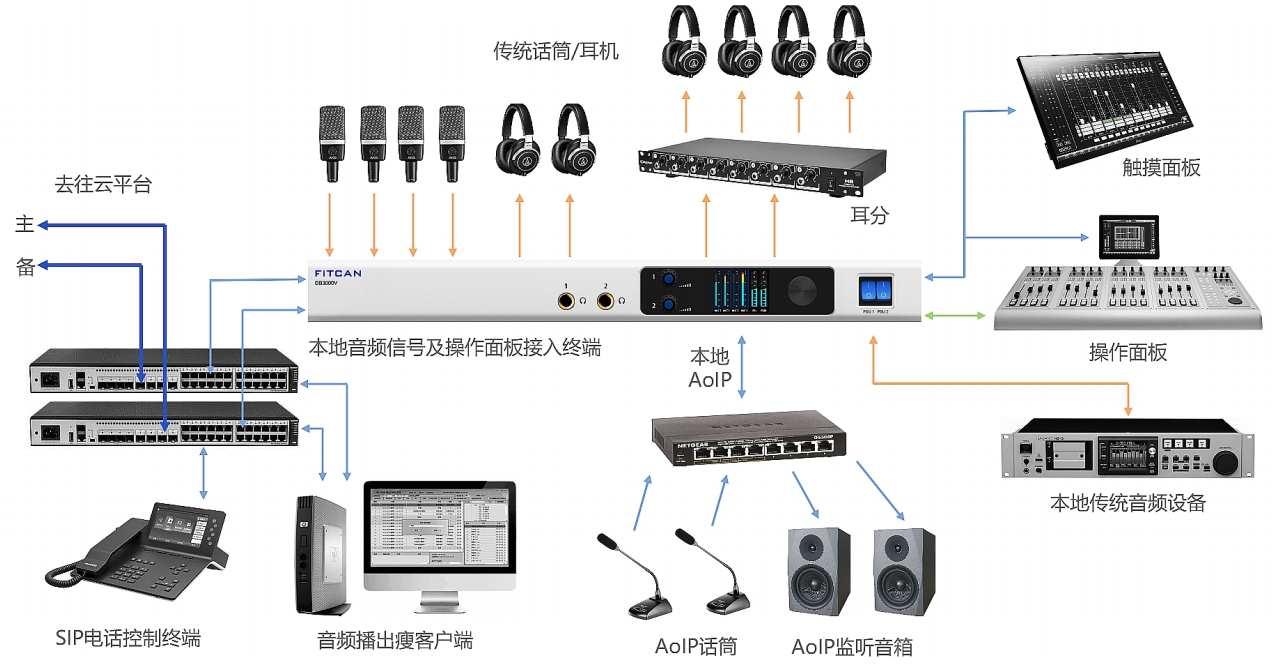
Integrated media application mode
:Control the mixing console through touch screen devices, and the processing scale and capacity can be applied as needed.
Virtual real mutual backup mode:The physical mixing console and the virtual mixing console on the cloud platform are processed in parallel to achieve heterogeneous backup and improve the reliability of the mixing console from the system architecture level.

